One client, two businesses — and a new website built to support her next big step.
A startup editing and proofreading website built from the ground up for clarity, credibility, and early SEO success. Precise Syntax’s WordPress and Elementor site blends strategy, simplicity, and craftsmanship — showing how thoughtful optimization can help a brand-new business gain visibility fast.
The Project at a Glance
Client: Precise Syntax
Location: Portland, OR (Serving clients worldwide)
Launched: October 2025
Platform: WordPress with Elementor
The Challenge
After seeing her first website climb the ranks on Google and bring a steady stream of new clients to The Cooperative Canine, Telani saw firsthand how powerful the right online strategy could be. That success gave her both the confidence and the flexibility to expand her professional reach — launching Precise Syntax, a new editing and proofreading company that draws on her background in writing and animal behavior science.
Unlike her first website, this new venture started completely from scratch — no existing content, no online presence, and no search footprint. Starting from ground zero, so to speak. She came to me with a newly designed logo and a clear vision for her brand voice, but everything else needed to be built from the ground up: the messaging, the layout, the content, and the entire SEO foundation.
Because the editing field is so saturated online, I knew that ranking for generic “editing” or “proofreading” terms wouldn’t be enough. I needed a targeted, intentional SEO strategy that could compete for buyer-intent traffic early — the kind of searches that come from writers and researchers who are ready to hire an editor, not just browsing for advice. The challenge was to build a site that felt professional and approachable, clearly communicated her niche expertise, and aligned every piece of content with both her brand positioning and real-world search intent.
The Strategy
The strategy began long before the content was ever written or the first page designed. Before writing a single headline or choosing a layout, I conducted a deep-dive keyword and intent analysis to understand exactly how her target clients — indie authors, publishers, and academic professionals — search for editing and proofreading services when they’re ready to hire.
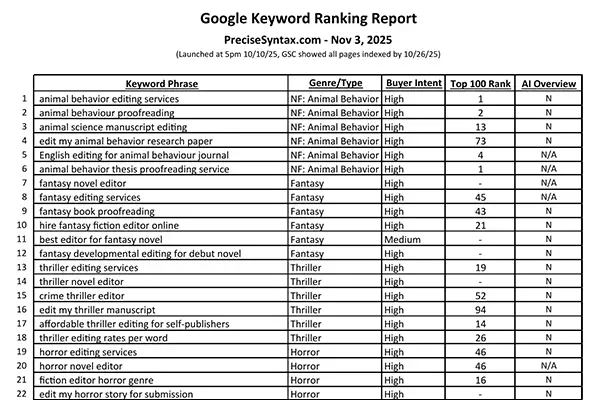
Buyer-intent keyword and genre research paired with the initial three-week post-launch ranking report that guided the content and SEO strategy for Precise Syntax. [ View Full Research and Ranking Report ]
I wasn’t just looking for high-traffic keywords. The goal was to uncover buyer-intent phrases — the exact wording people use when they’ve already decided to invest in editing help and are searching for the right professional. Searches like “copyeditor for fantasy novel,”“academic proofreading before journal submission,” and “line editing for self-published books” became the foundation for the site’s entire strategy.
Even in the smallest details — like a favicon site icon designed to pop out from a browser full of tabs or search result snippets written to speak directly to a reader’s problem — I was intentional. Instead of echoing the usual “Affordable editing and proofreading services” language that fills search results, her snippets were crafted as mini value propositions: first naming the challenge an author faces, then positioning Precise Syntax as the clear, confident solution.
Those subtle decisions matter, especially in a space where so many editing websites look nearly identical. The search landscape can be as monotonous as the endless horizon of the Mojave Desert — the same headlines, the same color palettes, the same generic promises of “professional editing,” and the same initials-only site icons floating together like alphabet soup. I wanted Precise Syntax to be the oasis — the search result that makes people pause, the one that feels different, clear, and click-worthy.
It’s the kind of micro-strategy most people overlook, but in a competitive field like editing, those few words and tiny visuals can make the difference between being scrolled past or clicked first.
The Build
With the strategy locked in, it was time to roll up my sleeves and bring it to life.
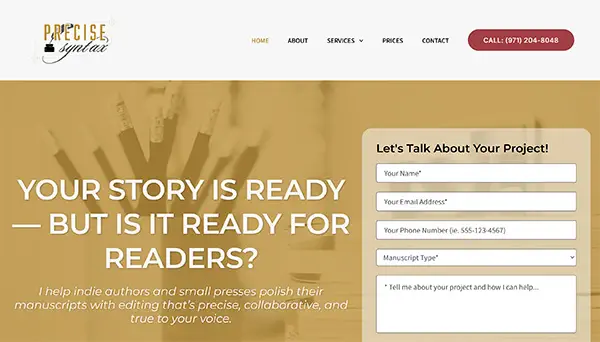
Visually, I took cues from her logo design and built a calm, editorial aesthetic that feels equal parts modern and timeless. Clean typography, generous spacing, and balanced color tones reflect the precision and focus of her work — no gimmicky animations or trendy effects, just thoughtful design that lets her message take center stage.
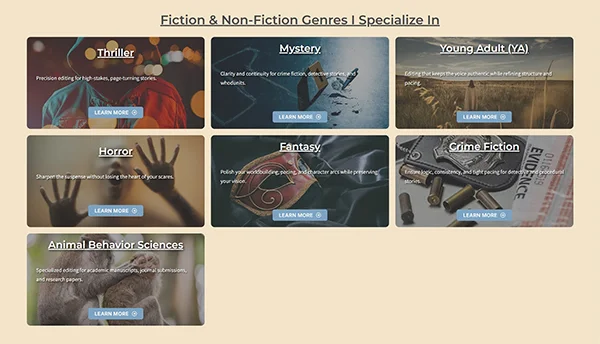
Genre-specific homepage design using tailored visuals to make each editing specialty instantly recognizable.
On the content side, I collaborated with Telani to build her brand story completely from the ground up:
A Home page carefully structured to introduce visitors (and search engines) to every key section and page of the site.
Genre pages tailored to her specialties — Thriller, Mystery, Fantasy, Horror, Young Adult, Crime, and Animal Behavior Science.
An About page highlighting her credentials and dual background in creative writing and animal behavior science.
A Plans & Pricing page outlining Copyediting, Line Editing, Proofreading, and Beta Reading services — written to be clear, concise, and easy to understand.
A custom-routed contact form that organizes project inquiries for faster, more efficient communication.
Because Precise Syntax was a brand-new business, every dollar mattered — and I wanted to be intentional about how those resources were used. A fully custom-coded site wasn’t in the budget this time, but that didn’t mean settling for less. Instead, I built the site on WordPress with Elementor, balancing affordability with flexibility — and proving that a startup can still have a polished, high-performing digital presence without the premium price tag.
Most WordPress sites rely heavily on widgets and plug-ins to function, but that convenience often comes at a cost: slower load times and clunky performance. And since page speed is a key ranking factor for SEO, keeping this build lean was critical — and a challenge I was more than ready for.
The key was making every choice count. Instead of leaning on add-ons, I wrote custom code wherever possible. When a plug-in was absolutely necessary, I researched and tested several free options to find the ones that offered the best combination of reliability, security, and compatibility. Free tools don’t always come with advanced features, so it took extra creativity and diligence to find solutions that performed well without weighing the site down.
In the end, I delivered what I like to call a hybrid WordPress–Custom Build — a clean, lightweight website that runs fast, looks professional, and feels effortless to use.
That build included:
Custom CSS and minimal widget use to reduce excess code
Hand-crafted SEO features built directly into the website’s back-end (no plug-ins)
Optimized images for fast loading without sacrificing clarity
Server-level performance tuning where the hosting platform allowed
Page-speed testing at every major milestone to maintain top performance.
From day one, my goal was to break the myth that WordPress and Elementor sites have to be slow — and the results speak for themselves.
The Results
All of that careful planning and behind-the-scenes fine-tuning didn’t just pay off — it paid off fast.
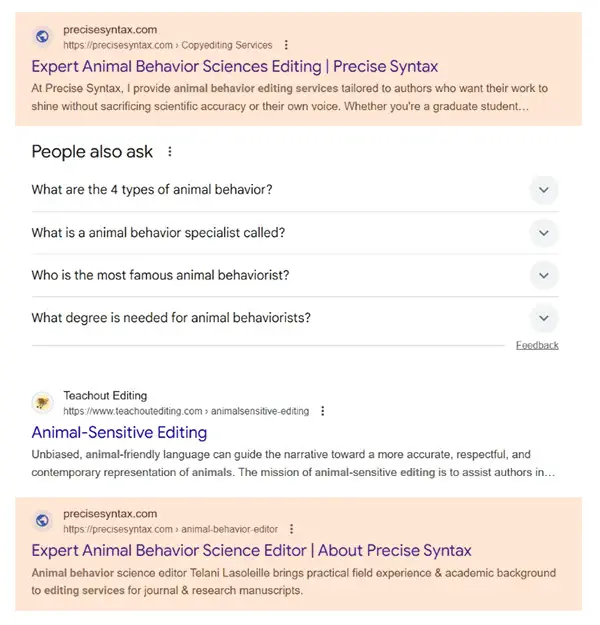
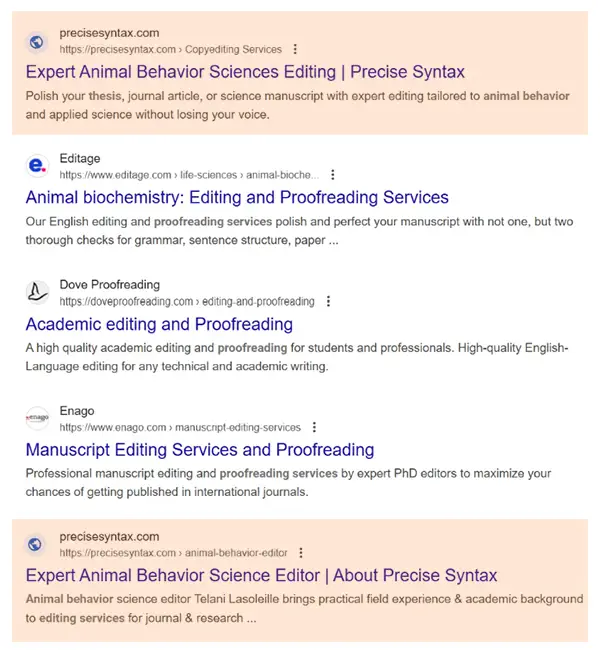
Google results for “animal behavior editing services,” show Precise Syntax appearing twice on Page One, with one result at the top and another ranked #3 — all within the first three weeks after the site went live. [ View full Google Search Results Page ]
Within just four days of launch, Google had already indexed her homepage (added it to their database). Even more impressive, it was showing up with the top ranking for the branded keyword phrase “Precise Syntax Copyediting.” That was an unexpected win, since “precise syntax” is actually a copyediting term — one typically dominated by well-established blogs and academic websites, not something you’d expect a four-day-old site to be ranking #1 for.
By the end of the third week, every page of the site was indexed, and the data from Google Search Console showed that the strategy was already working exactly as planned. To document this early success, I’ve included a snapshot of the three-week keyword ranking report, showing just how quickly Precise Syntax began gaining visibility across several editing genres.
#4 – “English editing for animal behaviour journal”
Top 15 placements in additional genres such as fantasy, crime, and thriller — including “affordable thriller editing for self-publishers” (#14) and “hire young adult fiction editor experienced in teen genre” (#14).
Google search results for “animal behavior thesis proofreading service,” with Precise Syntax appearing in the top position — plus a second internal page also ranking on Page One (#5) — just three weeks after launch. [ View full Google Search Results Page ]
Even more exciting, the site was already being found by real people through Google searches in the Portland, Oregon area — individuals actively looking for editing and proofreading help nearby. And the best part? Those visitors were finding Precise Syntax even though the website wasn’t specifically optimized for local keywords, since her goal was to reach a broader, worldwide audience. That means the site’s early visibility wasn’t just theoretical — real people were already discovering the business organically within weeks of launch.
It’s one thing to see data in a report, but it’s another to watch real people start finding a brand-new website on their own. That kind of early traction is rare. To put it into perspective, it can often take several months for a new website with no online history to have all its pages discovered and added to Google’s database, let alone start ranking on Page One for competitive search phrases. So when I saw this site hitting those milestones in just three weeks, I’ll admit — I may have done a little celebratory dance around my office.
At this early stage, Google is still processing certain display elements — such as the favicon and other visual details — which are in the queue waiting to be indexed. That’s completely normal for a new website, especially one starting fresh without any previous Google data or links from other sites (known as backlinks). As Google continues revisiting the site over the coming weeks, those remaining items will appear in search results and complete the full branded look.
While long-term growth takes time, Precise Syntax’s launch results already show what’s possible when strategy, clarity, and craftsmanship come together: a brand-new business ranking alongside established competitors within weeks — not months — and on a WordPress site, no less.
Special Touches
Every website I build has its own heartbeat, and for Precise Syntax, that pulse was precision itself — in tone, color, and content.
The logo — a clean typographic mark with subtle spacing and balanced symmetry — set the mood for everything that followed. Its simplicity became the visual metaphor for Telani’s work as an editor: removing what’s unnecessary so that clarity shines through. That same idea guided the color palette — soft neutrals paired with refined contrast — creating an environment that feels calm, capable, and intelligent without ever feeling sterile.
Typography also played a key role. I chose fonts that feel literary and modern at the same time — easy to read, yet sophisticated enough to resonate with both academic and creative audiences. The result is a site that feels quietly confident, just like its owner.
Voice mattered just as much as visuals. Each page was written to sound approachable and supportive, not stiff or overly formal. The copy speaks to writers in the same way Telani works with her clients — collaborative, clear, and respectful of the creative process.
Even the smallest design details were chosen with care. The navigation is simple and intuitive, the spacing feels open and comfortable, and each section flows naturally into the next — much like the calm, organized process Telani uses when she edits a manuscript.
Together, those subtle choices gave Precise Syntax a distinct personality — professional enough for universities and publishers, yet personal enough for first-time authors who just want to feel seen and understood.
Final Thoughts
Since this website just launched in October 2025, I’ll revisit this case study down the road with updates on Precise Syntax’s search visibility, growing keyword reach, and early client inquiries that turn into paying projects.
As the site continues to gain traction and Google builds more trust in the domain, I’ll be tracking its progress as part of my ongoing SEO monitoring. Like all new businesses, this is only the first chapter — but the foundation is solid, and every early sign points toward steady, sustainable growth ahead.
For now, Precise Syntax stands as a clear example of what can happen when strategy, clarity, and craftsmanship come together — a clean, confident launch that sets the stage for everything to come.
Want a Website Built on Real Understanding, Not Guesswork?
If you want someone who slows down, digs in, and truly learns how your ideal clients search, that’s how I approach every project. No shortcuts, tricks, or paid listings — just clear strategy and thoughtful decisions that help the right people find and trust your business. Let’s take the next step and start building something that works for you.
Franklin, Tennessee
Chat with us!
We’re currently unavailable for live chat, but we’ll respond by email as soon as possible.